
We can help with: rotator cuff injury, frozen shoulder and general shoulder joint pain.

We provide shoulder pain treatment for conditions such as rotator cuff pain, frozen shoulder (adhesive capsulitis), arthritis of the shoulder, sports injuries and general shoulder pain.
Shoulders are very important joints, which can become painful relatively easily. This is because they are a flexible joint which relies on muscles and ligaments for stability, rather than the bone structure (as, for example, the hip joint would).
Flexibility in the shoulder is of course very useful, but it also exposes the joint to injuries and chronic strains, as the muscles and ligaments can be pulled too far and injured, and tendons can become overused.
In a repetitive strain injury, pain develops if the same pattern of movement is repeated many times – for example when playing tennis or golf, working in the garden, in many manual vocations, or even typing at your desk.
Commonly, we encounter Rotator Cuff tears and strains, as this is the main muscle group which control and move the shoulder.
We can also help people suffering with shoulder blade pain – pain around or behind the shoulder blades, which often happens when sitting at a desk for long periods of time. We find the upper back and neck are usually also tight in these cases, so we will always assess and treat both areas during sessions.
We sometimes help patients with the management of Frozen Shoulder (medically known as adhesive capsulitis), by helping to maintain as much comfort and mobility as possible in the shoulders, back and neck.
We may also help patients as part of their rehabilitation process after a broken arm or fractured shoulder. We will provide massage and mobilisation to reduce pain, give advice on pain management and safe return to exercise, and guide you through the strength & rehabilitation process which is essential for full recovery and return to your level of activity before the injury.
Reduce pain with our new Laser Therapy – cutting edge technology in MSK health, used to reduce inflammation and accelerate tissue repair.
To understand the source of the problem, and exactly which structures are affected within the shoulder, we would first take the time to talk to you and note all the details about how the problem came about and when, how exactly the injury happened, or how you use your shoulder when it is painful.
We ask about the pattern of the pain – is it worse in the morning? Or at the end of the day? What makes it better? What makes it worse?
We find out how you use your arms and shoulders at work, during exercise and sport, and in other activities.
We also find out about any issues with your spine and the rest of the joints of the arm and hand. Your general health, and any significant events in the past such as accidents or surgery, are also important to note.
We then observe your shoulders, back and neck and assess movement in all directions – making note of any restrictions or pain. We will usually perform special tests to assess the nerves, joints, muscles and ligaments in the area and find where the problems are.
Once we have established our working diagnosis we will always take time to explain to you what we found, and let you know how we can help, and whether we need to make any referrals.
We then use specific massage, mobilisation and stretching techniques to improve the flexibility in joints and muscles, relieve tension, improve freedom of movement and mechanics, and ensure good circulation for effective recovery. We may use sports taping to support the injured area as it heals and provide additional stability.
With shoulder injuries, we always ensure that the healthy structures which are unaffected by injury are functioning at their best – supporting the vulnerable joint while the injured structures recover.
During the session, we also provide advice on exercise, posture and other techniques to aid fast recovery and maintain the treatment results.
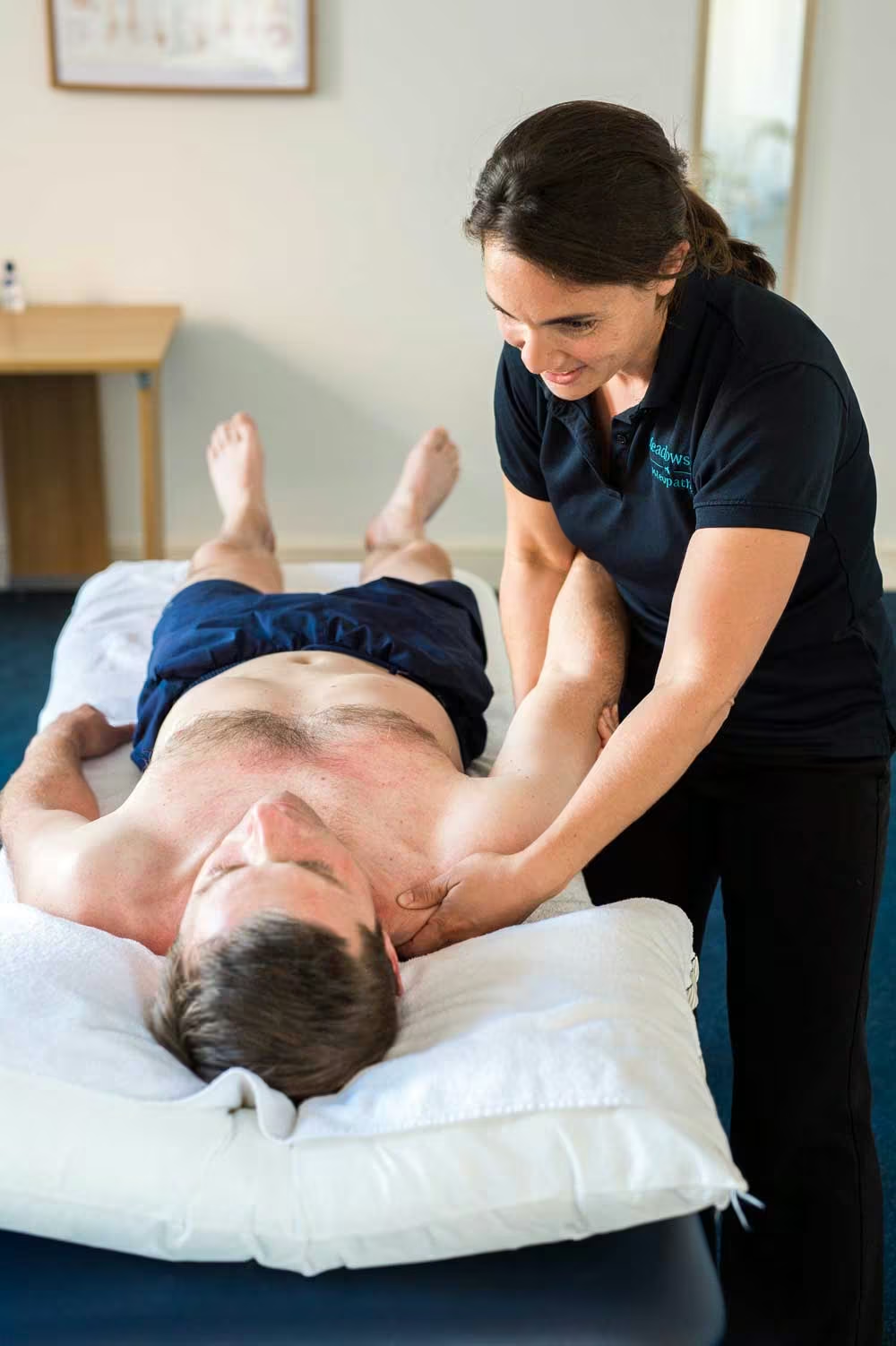
These are some of the most common techniques and exercises we prescribe for shoulder injuries or pain:
Variation: To increase the space created in the joint, you can add weight to the pendulum by holding a small weight or water bottle, or using a weight around your wrist. Do not do this if there is any suspected ligament injury in the joint.
Tips: You can start by standing sideways in front of a mirror as you do it, and observe the dramatic change in your posture. As this exercise is designed to change the habitual ’round-shouldered’ or ‘slouchy’ posture, the more frequently it is done the better.
By bringing the shoulders back to their neutral place, beside our chest and not in front of it, we are improving the arms’ ability to move freely in all directions, thus reducing the potential for strains and injuries at the end of their range of movement.
This posture is also better for the back and neck, as it creates better alignment through the spine and reduces demand on its muscles.
If your shoulders won’t allow you to do this exercise comfortably, you can try bending at the elbows and creating circles with the elbows instead, or just rolling the shoulders with your arms relaxed beside you, still following the movement with your head and neck for maximum effect to the spine.
Tip: To measure progress, you can ‘walk’ with your fingers up a wall next to a picture, and note how far along it you can reach every day. Aim to climb a little further each time.
Fees may be covered by your private insurance provider.
Aviva, Cigna, Simply Health, Vitality, WPA, BUPA and AXA PPP may cover your sessions with us, but this depends on your individual policy, so be sure to always check with your insurer before contacting us.
We kindly ask you directly pay for your appointment and claim your payment back from your insurance provider. Please get in touch with your provider prior to your appointment, to confirm you are covered and check what documentation is needed to process your claim.
We are happy to provide a detailed invoice to assist with your claim.
Please feel free to contact us if you have any questions or would like any further assistance with claiming Osteopathy on your insurance.












We and our partners, including Google, use cookies and personal data to analyse traffic and for ads personalisation and measurement. You can accept, reject or choose which cookies to allow. Privacy Policy • Cookie Policy • Terms & Conditions • Google Privacy
We use cookies to help you navigate efficiently and perform certain functions. You can choose which categories to allow below. Cookies categorised as Necessary are always active.
We also use third-party cookies for analytics and advertising. These are only stored with your consent. You can update or withdraw consent at any time via the cookie icon at the bottom-left. This site operates under UK GDPR, the Data Protection Act 2018, and the Privacy and Electronic Communications Regulations (PECR). Cookie Policy • Privacy Policy
Necessary cookies are required for core site features including security, network management, and consent storage.
| Cookie | Duration | Description |
|---|---|---|
hmdg_cookie_consent | 180 days | Stores your cookie consent preferences. |
PHPSESSID | Session | WordPress session identifier. |
wordpress_logged_in_* | Session | WordPress login authentication. |
Functional cookies enable enhanced features such as live chat and remembering preferences.
| Cookie | Duration | Description |
|---|---|---|
wp-settings-* | 1 year | Stores user interface preferences. |
Analytics cookies help us understand visitor behaviour. Controls analytics_storage for Google Analytics 4.
| Cookie | Duration | Description |
|---|---|---|
_ga | 2 years | Google Analytics — distinguishes users. |
_ga_* | 2 years | Google Analytics 4 — session persistence. |
_gid | 24 hours | Google Analytics — distinguishes users. |
_gat | 1 minute | Google Analytics — throttles request rate. |
Performance cookies collect aggregate, anonymous data about site performance.
| Cookie | Duration | Description |
|---|---|---|
_gat_gtag_* | 1 minute | Google Tag Manager — rate throttle. |
Marketing cookies track visits to deliver relevant ads. Controls ad_storage, ad_user_data, and ad_personalization.
| Cookie | Duration | Description |
|---|---|---|
_gcl_au | 90 days | Google Ads — conversion tracking. |
_gcl_aw | 90 days | Google Ads — click attribution. |
_gac_* | 90 days | Google Ads — campaign information. |
IDE | 1 year | Google DoubleClick — ad targeting. |
Powered by HMDG • Cookie Policy